
Filter Press Filter Cloth Installation
The core of filter press filter cloth installation boils down to three things: correct orientation, aligned holes, and uniform tension. If the installation is slightly off-center, loose, or the holes are misaligned, problems such as material leakage, liquid leakage, insufficient compression, and difficulty in unloading the filter cake will occur later. Below are the installation steps.
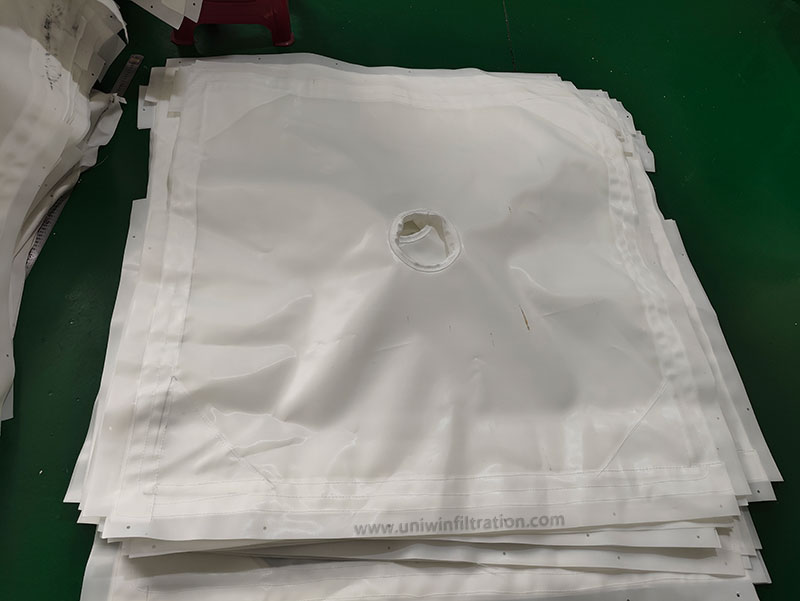
Verify the Filter Cloth Model
- Confirm that the filter cloth matches your filter press type: plate and frame, chamber, or diaphragm.
- Confirm that the dimensions are consistent: length, width, center hole, feed hole, and strap position.
- Confirm that the material matches the operating conditions: polyester, polypropylene, nylon, monofilament/multifilament, etc.
Check the Condition of the Filter Plates
- The surface of the filter plates must be flat and clean.
- The sealing edges must be free of residue, burrs, cracks, and deformation. The feed inlet must be unobstructed.
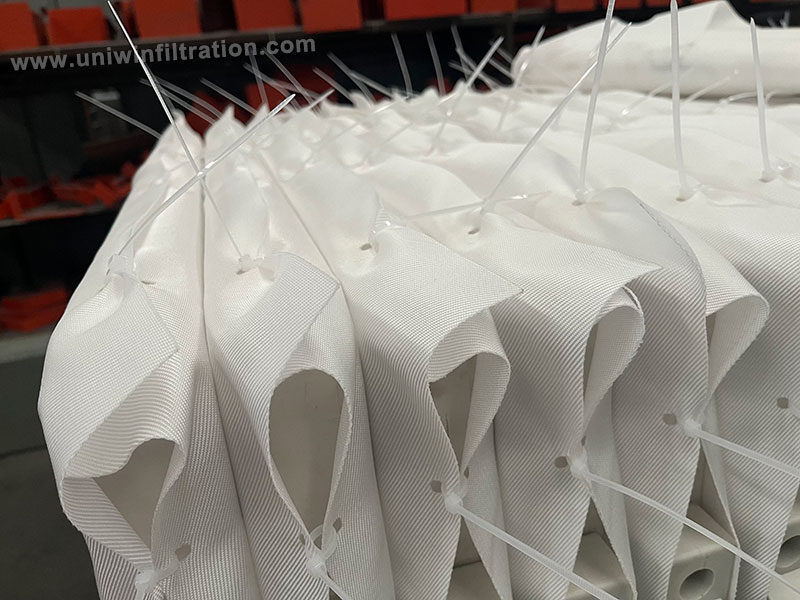
Filter Press Filter Cloth Installation Steps
Ordinary chamber-type filter cloth
This installation method is the most common. The key is to pass the filter cloth through the central hole of the filter plate, and then smooth and secure the filter cloth on both sides.
- First, roll up one side of the filter cloth.
- Pass the rolled-up side through the central hole of the filter plate.
- After passing it through, lay the filter cloth on both sides flat, ensuring there are no wrinkles, curled edges, or twists.
- Secure the filter cloth with cable ties.
Important notes
The center hole must be aligned to avoid uneven feeding.
The filter cloths on both sides must be kept flat and evenly taut.
After fixing, check for any folded or clamped edges.
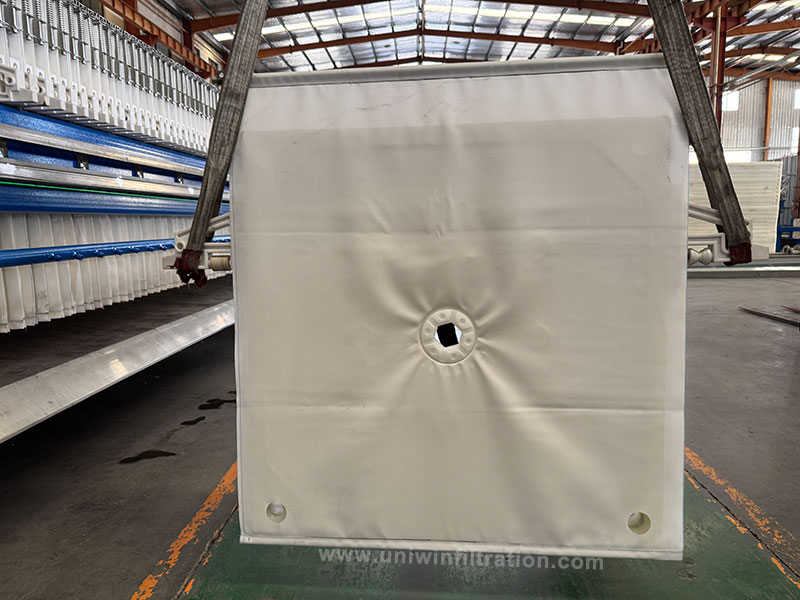
Plate and frame filter cloth
Plate and frame filter cloth installation is relatively simple. The main method is to directly drape the filter cloth over the filter plate.
- Unfold the filter cloth.
- Depending on the filter plate position, smoothly drape the filter cloth over it.
- Adjust the filter cloth to ensure accurate coverage and that the perforations align with the filter plate.
- Check that the edges of the filter cloth are flat, hang naturally, or fit well.
Important notes
The filter cloth must not be skewed or shifted.
After placement, ensure the effective filtration area is completely covered.
Avoid localized wrinkles, as these will affect compression and filtration efficiency.
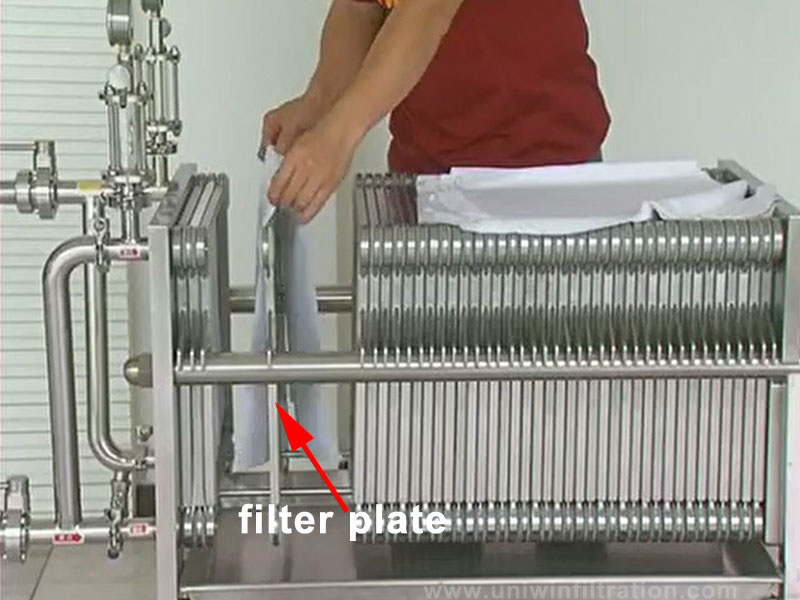
Gasketed filter cloth
The installation method for gasketed filter cloth is basically the same as that for ordinary filter cloth, but with an additional crucial step: embedding the edge sealing strip of the filter cloth into the groove of the filter plate to ensure a good seal.
- First, roll up one side of the filter cloth.
- Pass the rolled-up portion through the central hole of the filter plate.
- Unroll and flatten the filter cloth on both sides of the filter plate.
- Adjust the position of the filter cloth to ensure accurate alignment of the hole.
- Straighten the edges of the filter cloth and embed the edge sealing strip into the groove of the filter plate.
- Check that the sealing strip is fully and evenly embedded, ensuring the filter cloth is in a good sealing condition.
Important notes
The sealing strip must be fully inserted into the groove; it must not float or come out of the groove.
If the sealing strip is not properly embedded, it can easily cause material leakage and liquid spillage.
After installation, carefully check whether the seal around the filter plate is even.
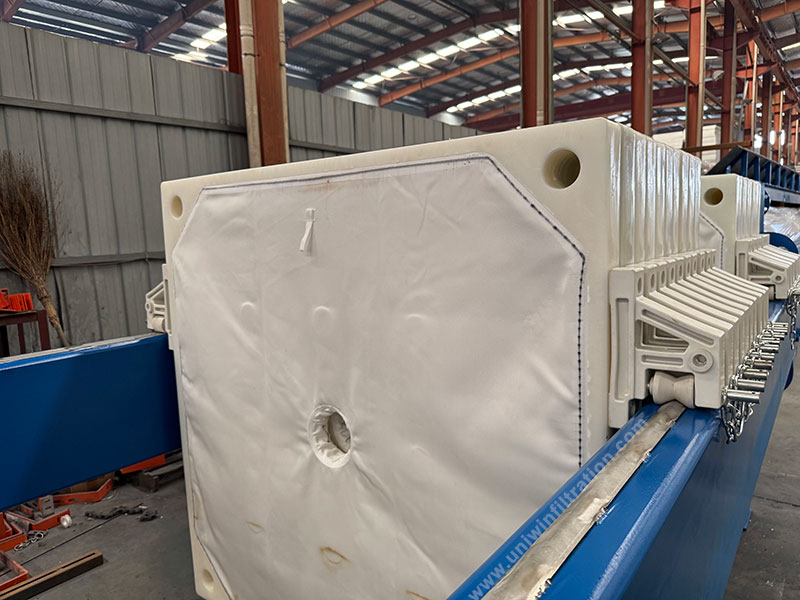
Inspection Methods After Installation
Empty machine inspection
- After assembling the plates, check if the edges of the filter cloth are neat.
- Check for obvious wrinkles.
- Check if the filter cloth is evenly sandwiched between each plate.
Pressure test with clean water
It is recommended to test run with clean water or a low-concentration material first, and observe:
- For leaks,
- For material spillage,
- For smooth liquid flow,
- For filter cloth displacement.
Key observations during initial operation
- Are there any abnormal changes in feed pressure?
- Is there any localized material spraying on a particular filter plate?
- Is the filter cake thickness uniform?
- Is the cake unloading process smooth?
Conclusion
The installation of filter cloth in a filter press should be carried out using appropriate methods according to the type of filter cloth. After installation, it should be ensured that the filter cloth is flat, securely fixed, has accurate hole positions, and is well sealed.