
Filter Press VS Belt Filter
Filter presses and belt filters operate on fundamentally different dewatering principles.
Belt filters use continuous operation to achieve a stable output, relying on gradual compression to dewater. Filter presses, on the other hand, use intermittent circulation to achieve higher pressure differentials and longer processing times, typically aiming for lower moisture content and clearer filtrate. Below is a detailed comparison of filter presses and belt filters.
Core Differences Comparison
Structural principle
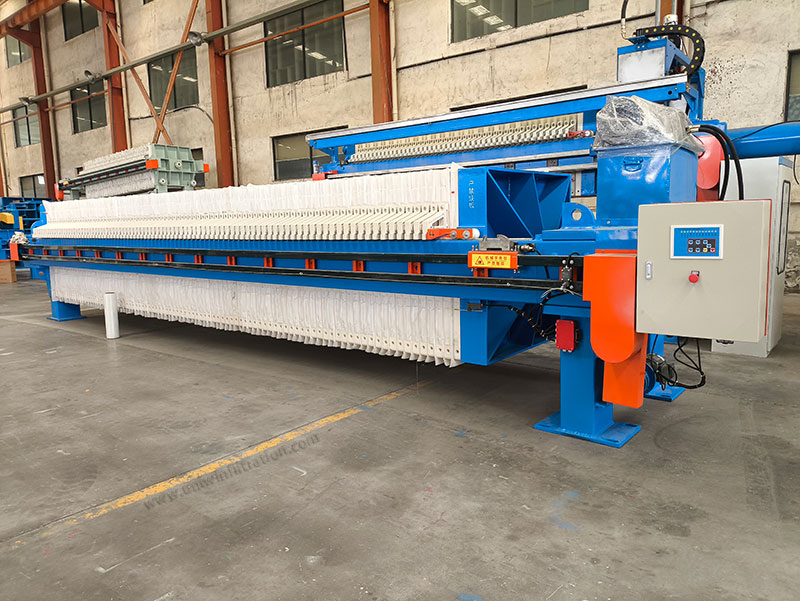
Filter press
Each filter plate has indentations on both sides. When two filter plates are closed, they naturally form a sealed filter chamber. Material is injected into the filter chamber under high pressure by a feed pump. Liquid passes through the filter cloth and is discharged, while solids are trapped to form a filter cake.
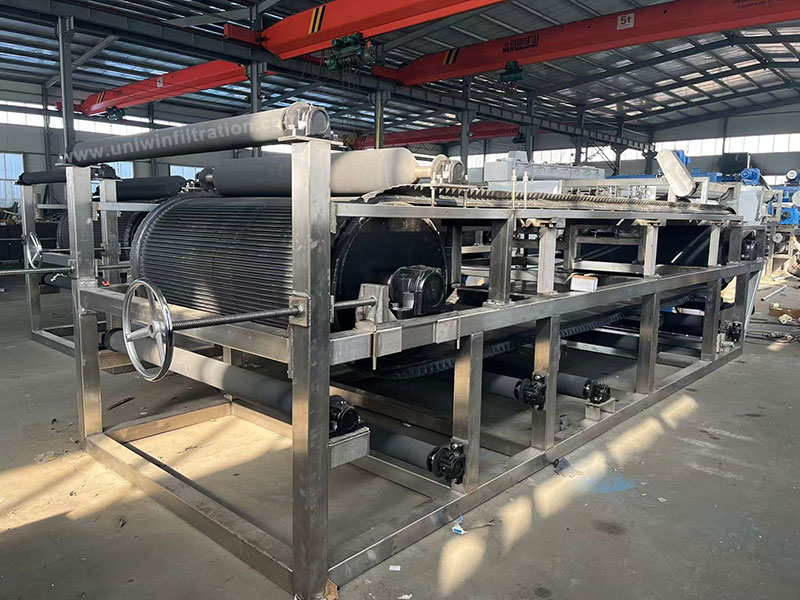
Belt filter
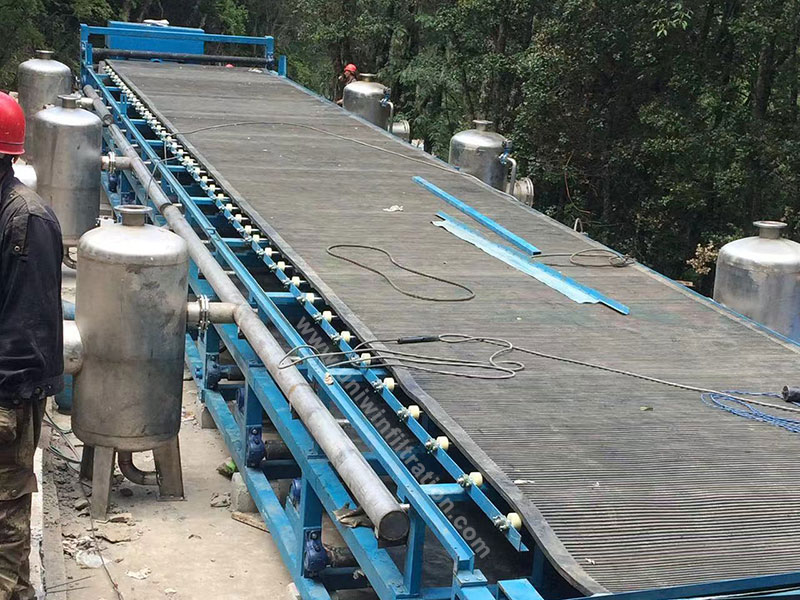
Uses two continuously running filter belts. Material passes sequentially through a gravity dewatering zone → a wedge pre-compression zone → a high-pressure roller compression zone, gradually squeezing out moisture.
Operating modes
Belt filter
The entire process—from sludge feeding, chemical dosing, dewatering, to cake discharge—is continuous. Suitable for scenarios with relatively stable sludge feed rates, and can be adjusted to some extent via frequency converter speed control.
Filter press
The cycle of “feeding—filtration—pressing (optional)—discharge—cloth washing/standby” is cyclical, making it more suitable for batch materials, scenarios with large fluctuations in feed rate, or scenarios requiring stronger separation.
If you require continuous operation, a belt filter is naturally superior; if you can tolerate batch cake discharge, a filter press is more suitable.
Footprint and layout
Equipment body footprint
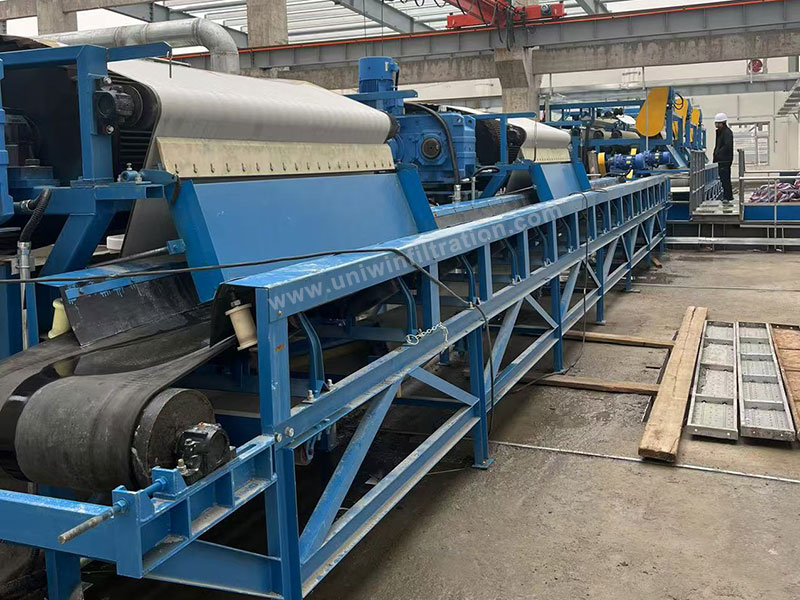
Belt filter press: The machine body is relatively long (gravity section + wedge section + roller pressing section + washing system), typically requiring a long straight-line layout.
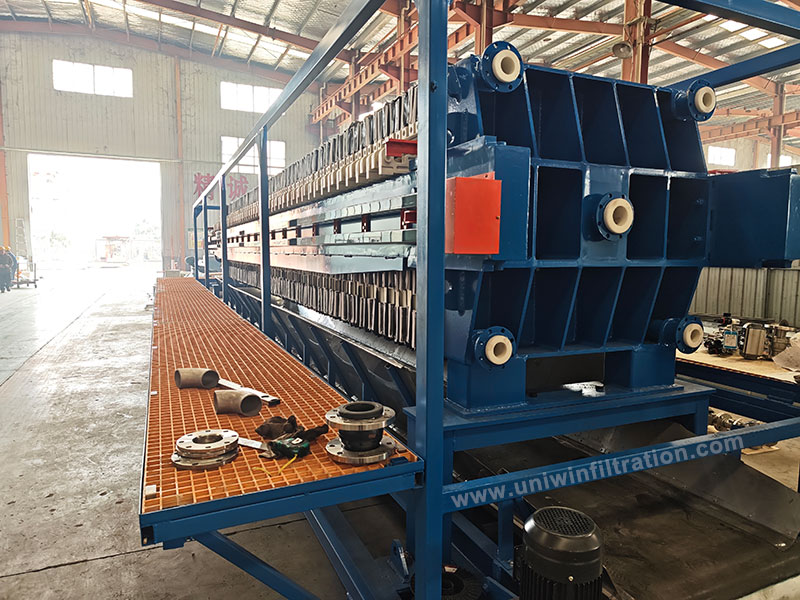
Filter press: The body is relatively “square,” but space needs to be considered for the cake discharge side, plate pulling/receiving, and maintenance plate removal space.
System footprint
Belt filter: typically requires a more complete flushing water system, filter belt tensioning and correction, liquid receiving, etc.
Filter press: requires a feed pump, air/water compressor (diaphragm machine), cake conveying/loading, filter cloth cleaning (if applicable), and the supporting facilities can be more centralized.
If the work area is long and narrow, a belt filter is more convenient to install; if the work area is more square and can accommodate a cake receiving system, a filter press is more convenient.
Labor requirements
Belt filter press
Daily operation is largely “caretaker-oriented”: handling chemicals, sludge feeding, filter belt misalignment, rinsing, sludge scraping, and floor cleaning.
High reliance on on-site cleaning and rinsing management; operators need to frequently inspect the filter belt condition.
Filter press
Traditional filter presses require manual labor for unloading, cloth laying/changing, sludge handling, and filter cloth cleaning.
However, with the development of automatic plate pulling, automatic liquid receiving and tilting, and automatic cleaning systems, manual labor can be significantly reduced.
If automation is well implemented, filter presses can operate with “minimal staffing.” Without automation, or if material sticking or cake unloading is poor, the manual labor requirements for filter presses will fluctuate greatly.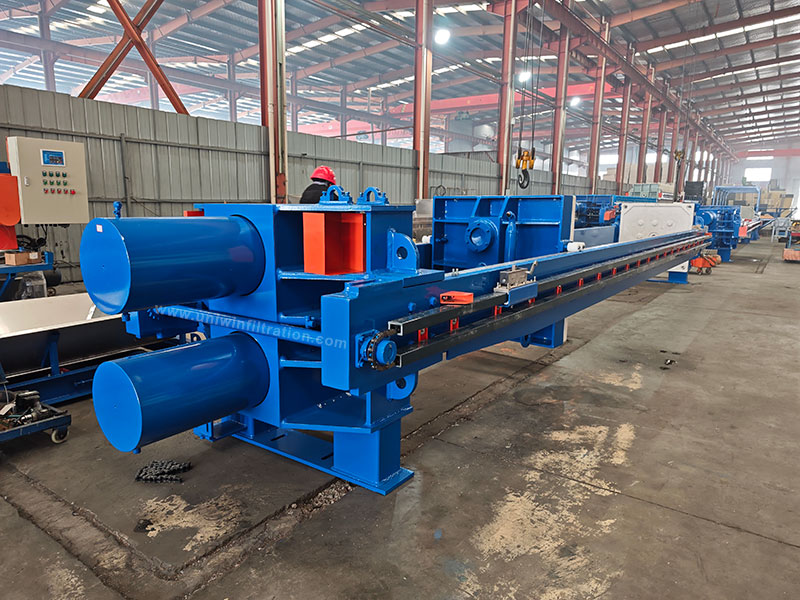
Moisture content
Belt filters have limited dehydration pressure due to their structure, resulting in a limited achievable moisture content.
Pressure filtration (especially diaphragm pressure filtration) can achieve lower moisture content through higher pressure differentials and more thorough pressing.
Conclusion
The two are not simply substitutes. In practical engineering, some projects use them in combination: belt filters for high-flow-rate initial dewatering at the front end, and filter presses for deep dewatering at the back end, balancing efficiency and dewatering effect. When selecting a model, it is necessary to comprehensively consider material characteristics, target moisture content, throughput, site conditions, and total life cycle cost.